
Gopashtami
Gopashtami is the festival of the cows on Kartik Shukla Ashtami, the day Lord Krishna and Lord Balarama first took the cows to pasture. In 2027 it falls on Saturday, 6 November.
By ISKCON KurukshetraFestivals0 comments
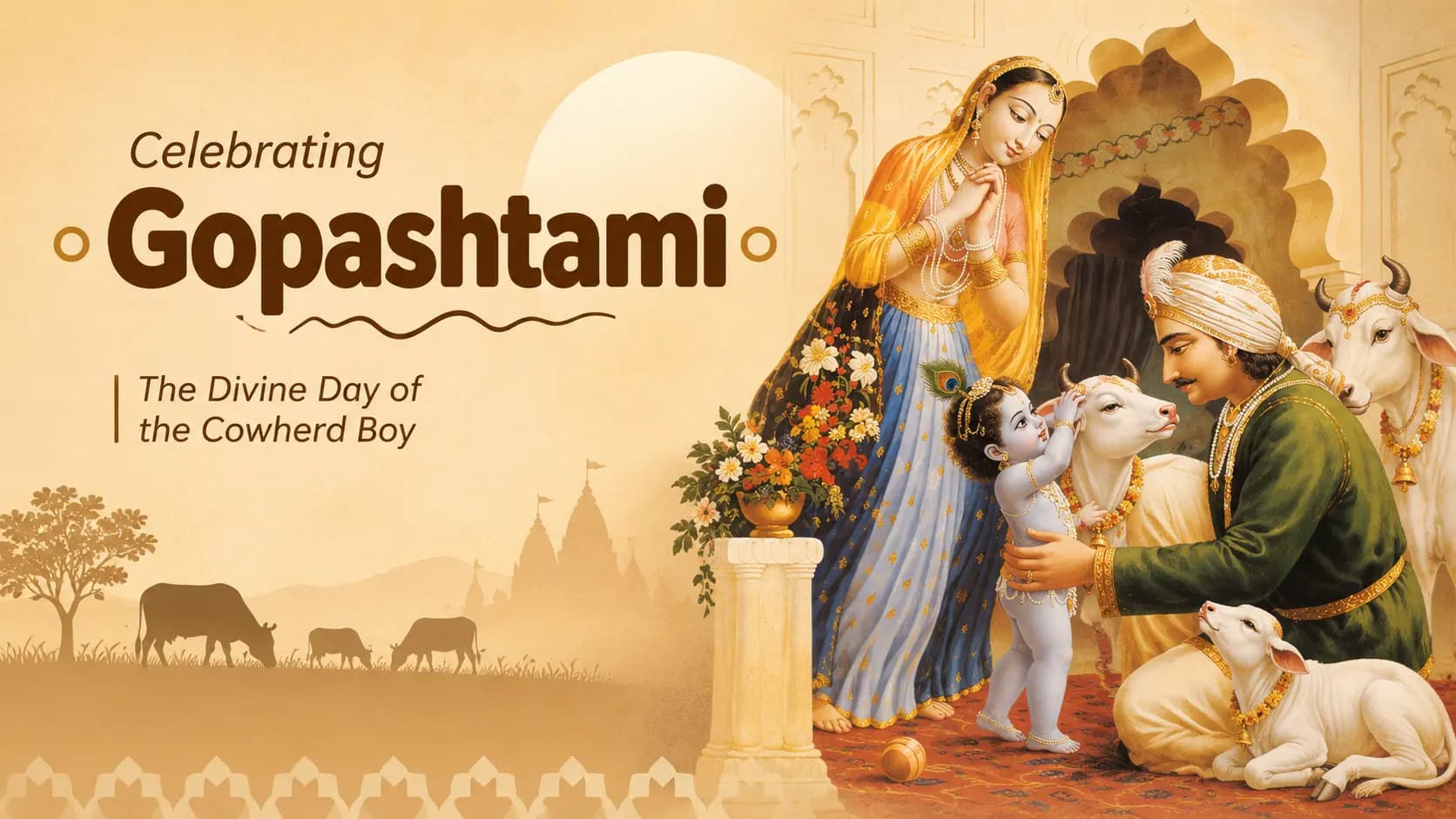
Gopashtami is the festival of the cows, observed on the eighth day of the bright fortnight of Kartik (Kartik Shukla Ashtami). On this day Lord Sri Krishna and Lord Balarama were first given charge of the full herd of cows in Vrindavan. Gopashtami 2027 falls on Saturday, 6 November 2027. In 2026 it was observed on Tuesday, 17 November.
Gopashtami at a Glance
Festival | Gopashtami (Gosthashtami, Goshtha Ashtami, Gopa Ashtami) |
|---|---|
Date in 2027 | Saturday, 6 November 2027 |
Tithi | Kartik Shukla Ashtami, the eighth day of the bright fortnight of Kartik |
Remembers | The day Lord Krishna and Lord Balarama first took the cows to pasture |
Worshipped | Lord Krishna as Gopala and Govinda, and the cows and calves |
Main practices | Gau puja, feeding cows, gau seva, kirtan, hearing the pastime |
Scripture | Padma Purana, quoted in Srimad-Bhagavatam 10.15.1, purport |
Comes after | Govardhan Puja, one week earlier |
Gopashtami 2027 Date
Gopashtami 2027: Saturday, 6 November 2027
Ashtami tithi begins: 12:09 AM, 6 November 2027
Ashtami tithi ends: 2:49 AM, 7 November 2027
Gopashtami 2026: Tuesday, 17 November 2026
A tithi begins and ends at the same moment everywhere, because it depends on the position of the moon. So these times hold for every city in India in IST: Delhi, Kurukshetra, Mumbai, Kolkata, Chennai, Bengaluru or Vrindavan. Outside India the same moment falls at a different local clock time, so check a calendar for your own city. Gopashtami comes one week after Govardhan Puja and falls within Kartik, the month of Lord Damodara.
What Is Gopashtami?
The name joins two words: go, the cow, and ashtami, the eighth day of the moon. It is also known as Gosthashtami, Goshtha Ashtami and Gopa Ashtami. Until this day little Krishna had looked after only the calves near the village. From Gopashtami onwards He went out to the pastures with the grown cows, as a true cowherd boy, a gopa. This is the Krishna whom devotees call Gopala, the protector of the cows, and Govinda, the one who gives pleasure to the cows.
Gopashtami Story from Srimad-Bhagavatam
The pastime is told at the start of the Tenth Canto, Chapter Fifteen, of Srimad-Bhagavatam. Krishna and Balarama had grown out of their earliest childhood. They were now in the pauganda age, between six and ten years, and Their bodies had become a little taller and stronger. The elder cowherd men, led by Nanda Maharaja, talked it over among themselves and agreed that the two boys were ready. From calf herding They would now be promoted to herding the cows.
Srila Prabhupada adds a tender detail in his purport. Krishna had His own reason for going deeper into the forest. His friends had lately been through hard days: they had been swallowed by the demon Aghasura, and then Lord Brahma had stolen them away. Krishna wanted to cheer them up, so He chose to take them to Talavana, the forest of palm trees.
So the morning came when the cows went ahead and the boys followed. Balarama walked beside His younger brother, the cowherd friends crowded around Them, and Krishna entered the forest playing His flute. In the Krsna Book Srila Prabhupada describes it in one line:
"Given charge of the cows, Kṛṣṇa and Balarāma traversed Vṛndāvana, purifying the land with Their lotus footprints."
(Kṛṣṇa, the Supreme Personality of Godhead, Chapter 15)
Think of who is walking behind these cows. He is the Lord whom great yogis try to see in meditation for lifetimes, and here He is a small boy with a stick and a flute, happy because the elders have trusted Him with the herd. The love moving this scene is vatsalya, the love of Nanda and Yasoda and the elders for their child, and sakhya, the easy love of His friends. Brahma himself sings of this Lord in the Brahma-samhita:
चिन्तामणिप्रकरसद्मसु कल्पवृक्षलक्षावृतेषु सुरभीरभिपालयन्तम् ।
लक्ष्मीसहस्रशतसम्भ्रमसेव्यमानं गोविन्दमादिपुरुषं तमहं भजामि ॥cintāmaṇi-prakara-sadmasu kalpa-vṛkṣa-
lakṣāvṛteṣu surabhīr abhipālayantam
lakṣmī-sahasra-śata-sambhrama-sevyamānaṁ
govindam ādi-puruṣaṁ tam ahaṁ bhajāmi"I worship Govinda, the primeval Lord, the first progenitor who is tending the cows, yielding all desire, in abodes built with spiritual gems, surrounded by millions of purpose trees, always served with great reverence and affection by hundreds of thousands of lakṣmīs or gopīs."
(Śrī Brahma-saṁhitā 5.29)
In the spiritual world Krishna is always tending the cows. Gopashtami is the day that same pastime began on earth, in Vrindavan.
Gopashtami in Shastra
The day is named in the Padma Purana, and Srila Prabhupada quotes the verse in his purport to Srimad-Bhagavatam 10.15.1:
śuklāṣṭamī kārttike tu smṛtā gopāṣṭamī budhaiḥ
tad-dinād vāsudevo 'bhūd gopaḥ pūrvaṁ tu vatsapaḥ(Padma Purana, quoted in Srimad-Bhagavatam 10.15.1, purport)
The meaning: learned authorities know the eighth day of the bright fortnight of Kartik as Gopashtami. From that day Lord Vasudeva became a gopa, a cowherd; before it He was a vatsapa, one who tends the calves.
Krishna and His Cows
Krishna knows every cow in His herd. Once, in the Ishikatavi forest, the cows wandered off and were caught by a forest fire. Krishna called out to them one by one, and the Bhagavatam says:
"Hearing the sound of their own names, the cows were overjoyed and called out to the Lord in reply."
(Śrīmad-Bhāgavatam 10.19.6)
The cows love Him back. After Krishna lifted Govardhan Hill, mother Surabhi, the cow of the heavenly planets, came to Him and performed His bathing ceremony with her own milk. Then Indra bathed Him with Ganga water and gave Him the name Govinda (Śrīmad-Bhāgavatam 10.27.22-23).
Why the Cow Is So Dear to Lord Krishna
Krishna's own childhood is spent among the cows of Vraja. He wakes with them, eats His lunch in the pastures beside them and comes home with them at dusk. In the Bhagavad-gita (18.44) He names cow protection, along with farming and trade, as the natural work of the vaishyas. For a devotee, caring for a cow is caring for someone Krishna loves.
How to Do Gau Puja on Gopashtami
You do not need a large goshala to keep this day. Choose what fits your home and your town.
Begin early. Bathe in the morning, put on clean clothes and chant a few rounds of the Hare Krishna maha-mantra.
Go to the cows. Visit a goshala, or a family nearby that keeps a cow. Ask before you touch or feed any animal.
Serve the cow and calf. Devotees help bathe them, put a little tilak on their foreheads and offer a garland of flowers.
Feed them. Offer green grass, rotis, jaggery or bananas, whatever the goshala allows.
Walk around them. Many devotees go once around the cow with folded hands, chanting.
Worship Krishna as Gopala. At home or in the temple, offer a ghee lamp to the Lord, as devotees do every evening of Kartik, and sing Damodarashtakam.
Hear the pastime. Read Srimad-Bhagavatam Canto 10, Chapter 15, or Chapter 15 of the Krsna Book with your family.
Greet the cows at dusk. In Vraja the evening hour when the herds come home is called godhuli, the hour of cow dust. If cows pass your lane, offer them something to eat.
The maha-mantra to chant through the day:
Hare Kṛṣṇa Hare Kṛṣṇa Kṛṣṇa Kṛṣṇa Hare Hare
Hare Rāma Hare Rāma Rāma Rāma Hare Hare(the Hare Krishna maha-mantra)
Gau Puja and Gau Seva: What Is the Difference?
Gau puja is the worship you offer on the day itself: the tilak, the garland, the lamp and the food you give with your own hands. Gau seva is the care a cow needs every day of the year: fodder, shelter, medicine and someone to look after her when she is old. A cow fed once on Gopashtami still has to eat tomorrow, which is why many devotees give gau seva on this day. Most goshalas accept sponsorship for a day of fodder, a month of care or medicine for sick and old cows.
How Gopashtami Is Celebrated
The day is kept with the most feeling in Braj, in Mathura, Vrindavan and the villages around Govardhan, where Krishna actually grazed His cows. Wikipedia lists Gaudiya Vaishnavas and the Radha Vallabha sampradaya among those who celebrate it most widely, and Vaishnava temples across India and abroad hold go puja, kirtan and feasts near their goshalas. In Guwahati a three-day Gopastami Mela has been held, according to a 2017 report in NorthEast India24. Drik Panchang notes that the cow and calf worship of Gopashtami is similar to Govatsa Dwadashi, observed in Maharashtra.
Hare Krishna Spiritual Journey
Seek the Divine.
Transform Your Soul.
Join the ISKCON KKR community — embrace bhakti, serve with love, and discover your eternal purpose.
About the Author
ISKCON Kurukshetra
A team of devotees dedicated to sharing the timeless wisdom of Vedic scriptures and the teachings of Lord Krishna for the benefit of all seekers.
Our mission is to spread the message of Bhagavad Gita and Srila Prabhupada’s teachings with authenticity and devotion.

Comments