
Harinam Sankirtan
Harinam Sankirtan is street chanting of the Hare Krishna maha-mantra, begun by Sri Chaitanya to share God's name with everyone.
By ISKCON KurukshetraGeneral0 comments
What is Harinam Sankirtan?
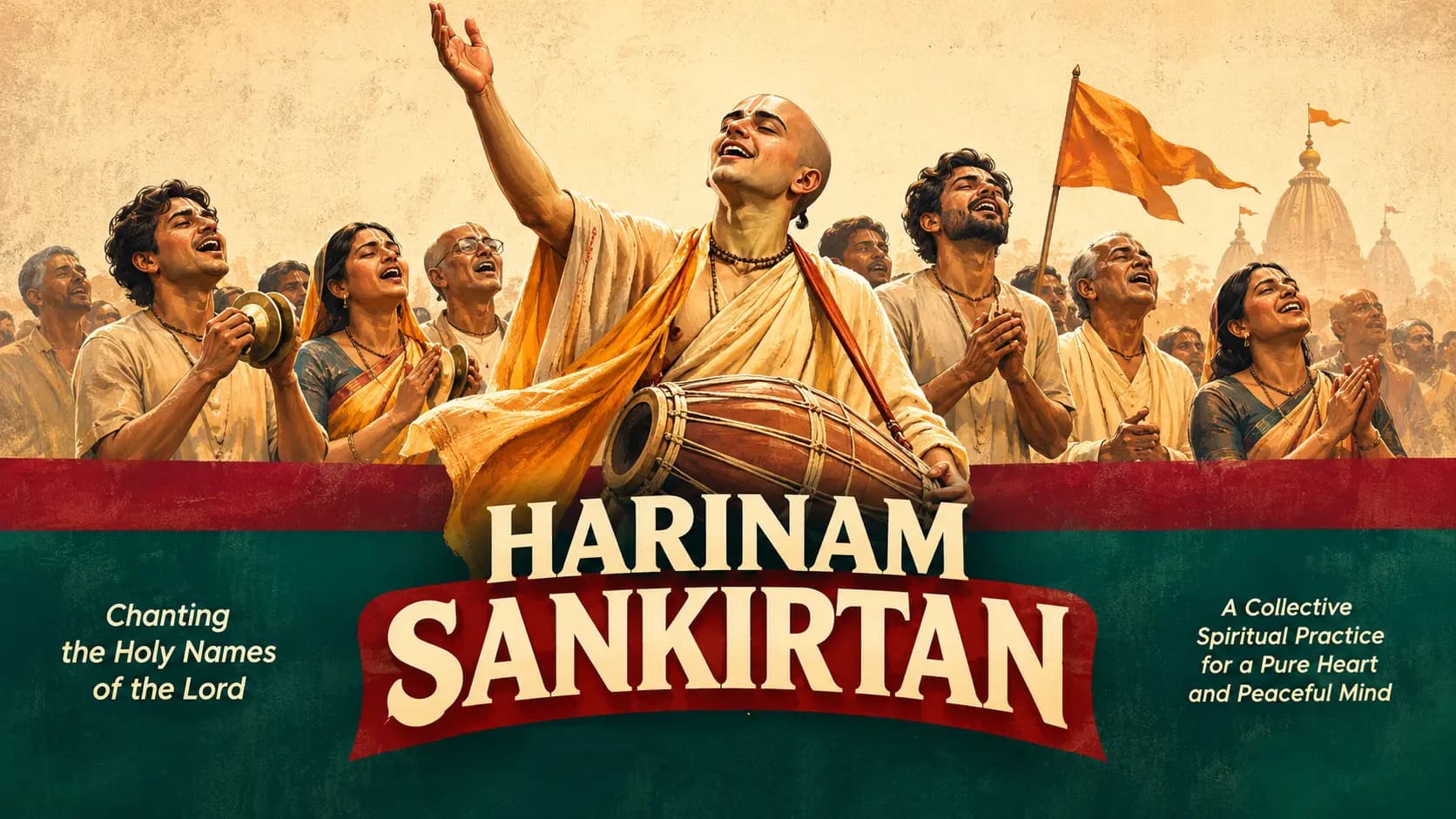
Harinam Sankirtan (also spelled Harinaam Sankirtan or Harinama Sankirtana) is the loud, congregational chanting of the holy names of Krishna and Rama, usually the Hare Krishna maha-mantra. Devotees walk through streets singing to mridanga drums and kartals, which is why it is also called Nagar Sankirtan. Sri Chaitanya Mahaprabhu made it popular in 16th-century Bengal, within the Gaudiya Vaishnava bhakti tradition. He gave it as the yuga-dharma, the main spiritual practice for Kali-yuga.
You have probably seen it, even if you didn't know its name. A group in saffron and white comes down the road, a drum sets the rhythm, and someone in front sings a line that everyone else answers. Shopkeepers step out. Children follow for a few steps. An auto driver slows down and smiles.
That moment is Harinam Sankirtan. In this guide we explain what the words mean and where the tradition comes from. We also explain what happens on a Harinam, and how you can walk with us here in Kurukshetra, the land where Krishna spoke the Bhagavad Gita.
Meaning: Harinam vs Sankirtan vs Kirtan vs Japa
The name breaks into three Sanskrit parts. Hari means the Lord who takes away (harati) our troubles. Nam means name. Sankirtan joins sam (together, completely) with kirtan (glorifying aloud). Harinam Sankirtan means "glorifying the Lord's name together, out loud".
These four words are often used interchangeably, but they mean slightly different things:
Practice | How it's done | Where | Who |
Japa | Softly chanting the maha-mantra on beads | Anywhere, usually early morning | One person, alone |
Kirtan | Singing the holy names aloud, often with instruments | Temple hall or home | A group sitting together |
Sankirtan | Kirtan done together; also used for sharing Krishna's message, including book distribution | Anywhere | A community |
Harinam Sankirtan | Kirtan taken out walking through the streets | Roads, markets, parks, ghats | Devotees plus anyone who joins on the way |
The simple difference: japa is chanting to Krishna, and Harinam is chanting with the whole town. Most devotees do both. Japa builds steadiness inside, and Harinam shares it outside. If you would like to start japa at home, our guide to Krishna mantras and shlokas is a good first step.
Where Did Harinam Sankirtan Begin?
Harinam Sankirtan comes from the scriptures, but Sri Chaitanya Mahaprabhu (1486–1534) is the one who took it onto the streets.
What the scriptures say
Bhagavad Gita 9.14, spoken right here in Kurukshetra: "satataṁ kīrtayanto māṁ…" Krishna says great souls are always glorifying Him with devotion. Kirtan is part of the Gita's own teaching.
Srimad Bhagavatam 11.5.32 says that in Kali-yuga, intelligent people worship the Lord through "yajñaiḥ saṅkīrtana-prāyaiḥ", sacrifices made up mainly of congregational chanting.
Srimad Bhagavatam 12.3.51 says that Kali-yuga is an ocean of faults, but has one great quality: simply by chanting Krishna's name, a person becomes free and reaches the Supreme.
Kali-santarana Upanishad gives the sixteen-word Hare Krishna maha-mantra. It calls the mantra the destroyer of the faults of Kali.
Also Read: https://iskconkurukshetra.org/vigrah-seva/
Chand Kazi: The Story of the First Civil Disobedience Movement
In Navadvipa, Bengal, the local magistrate Chand Kazi banned public kirtan. He came into a devotees home and broke a mridanga to make his point.
Sri Chaitanya didn't argue, and he didn't hide. He called the whole town out for one evening of kirtan. Thousands came carrying torches, singing the holy names, and walked all the way to the Kazi's house. Srila Prabhupada called this the first nonviolent civil disobedience movement.
The ending is the most beautiful part. Mahaprabhu sat and talked with the Kazi respectfully, as a relative, and the Kazi had a change of heart. He promised that no one in his family would ever stop sankirtan again. The full account is in Chaitanya-charitamrita, Adi-lila chapter 17.
How an Ancient Prophecy Came True
The Chaitanya Bhagavata (Antya-khanda 4.126) records Mahaprabhu's prediction: "pṛthivīte āche yata nagarādi-grāma, sarvatra pracāra haibe mora nāma". In every town and village on earth, His name will be heard.
For 400 years that sounded impossible. Then on 9 October 1966, Srila Prabhupada sat under a tree in Tompkins Square Park, New York, with a few young followers and a pair of kartals, and chanted. That afternoon is remembered as ISKCON's first public kirtan in the West. Today Harinam processions walk through cities on every continent, and Mahaprabhu's prediction is coming true one street at a time.
What Happens During Harinam Sankirtan?
A Harinam looks spontaneous, but it has a simple structure that anyone can follow on their first day.
Gathering and a Short Prayer. Devotees meet at the temple or a set point. Many begin by singing a prayer to the spiritual master, then ask Lord Nityananda and Sri Chaitanya for mercy before setting off.
Kirtan Leader Sets the Tune. One devotee sings each line of the maha-mantra, and the whole group sings it back. You never need to know the words in advance, because you just repeat what you hear.
Instruments Keep the Beat. The mridanga (a clay two-headed drum) and kartals (brass hand cymbals) carry the rhythm. Sometimes there is a harmonium or a big drum on festival days. The tempo starts slow and builds as the walk goes on.
Walking the Route. The group moves at a gentle pace through lanes, markets or ghats, stopping where people gather. Some devotees dance; others simply walk and sing.
Sharing Prasadam and Books. A few devotees walk alongside, offering sweets, flyers or the Bhagavad Gita to anyone curious. Nobody is pressured, and a smile counts as much as a purchase.
Closing at the Temple. The group returns, offers obeisances and often shares a little prasadam together.
Most Harinams last 60 to 90 minutes. You can join for ten minutes or the whole walk.
First Harinam Experience: Simple Tips for Everyone
Nobody expects you to know anything. These small things just make it easier:
Wear Something comfortable. Simple, modest clothes and walking shoes or sandals are fine. A dhoti or saree is welcome but not required.
Sing Back, Even Softly. Follow the leader's tune. If you lose the words, just keep singing "Hare Krishna" and you'll catch up.
Stay Near the Group. Walk behind the kirtan leader, and keep clear of the mridanga player's elbows.
Carry water, not snacks. Prasadam is usually shared at the end.
Be kind on the road. Let traffic and pedestrians pass. If someone asks a question, answer gently or point them to a senior devotee.
Bring a friend. Harinam is the easiest way to introduce someone to Krishna consciousness, with no lecture and no pressure, just the holy name.
Sri Chaitanya's own instruction (Shikshashtakam, verse 3) is the best guide. Be humbler than a blade of grass, more tolerant than a tree, and offer respect to everyone. That mood matters more than a perfect tune.
Frequently asked questions
Q. Who started Harinam Sankirtan?
Sri Chaitanya Mahaprabhu started public Harinam Sankirtan in Navadvipa, Bengal, in the early 1500s. Srila Prabhupada, founder of ISKCON, brought it to the West in 1966, beginning with a kirtan in Tompkins Square Park, New York.
Q. What is the difference between Harinam and Sankirtan?
Harinam means "the Lord's name", and Sankirtan means "glorifying together". Sankirtan is the broad term for congregational chanting and preaching. Harinam Sankirtan is the specific practice of chanting the holy names while walking in public.
Q. Do I need to be initiated or a Hindu to join?
No. Harinam Sankirtan is open to everyone, whatever their age, background or faith. You don't need to register, pay or know the mantra in advance.
Q. Which mantra is chanted in Harinam Sankirtan?
The Hare Krishna maha-mantra: Hare Krishna Hare Krishna, Krishna Krishna Hare Hare, Hare Rama Hare Rama, Rama Rama Hare Hare. Other bhajans and prayers are sometimes sung too.
Q. What instruments are used in Harinam?
Mainly the mridanga (a two-headed clay drum) and kartals (brass hand cymbals). Some groups add a harmonium, a dhol or a large drum on festival days.
Q. Is Harinam Sankirtan only for ISKCON devotees?
No. Harinam belongs to the Gaudiya Vaishnava tradition started by Sri Chaitanya, and many groups practise it. ISKCON has simply helped carry it to cities around the world.
Q. Can I do Harinam Sankirtan at home?
Yes. Chanting the holy names with family is home kirtan. Walking around your colony or society with a few friends is a small Harinam. Keep it peaceful, and follow local rules on sound.
Hare Krishna Spiritual Journey
Seek the Divine.
Transform Your Soul.
Join the ISKCON KKR community — embrace bhakti, serve with love, and discover your eternal purpose.
About the Author
ISKCON Kurukshetra
A team of devotees dedicated to sharing the timeless wisdom of Vedic scriptures and the teachings of Lord Krishna for the benefit of all seekers.
Our mission is to spread the message of Bhagavad Gita and Srila Prabhupada’s teachings with authenticity and devotion.
Comments