
Tulsi Vivah
Tulsi Vivah 2027 will be celebrated on Thursday, 11 November 2027. It is the ceremonial wedding of the holy Tulsi plant with Lord Vishnu, who is worshipped in the form of a Shaligram stone. The festival falls on Kartik Shukla Dwadashi, the day after Dev Uthani (Prabodhini) Ekadashi, and it opens the Hindu wedding season.
By ISKCON KurukshetraFestivals0 comments
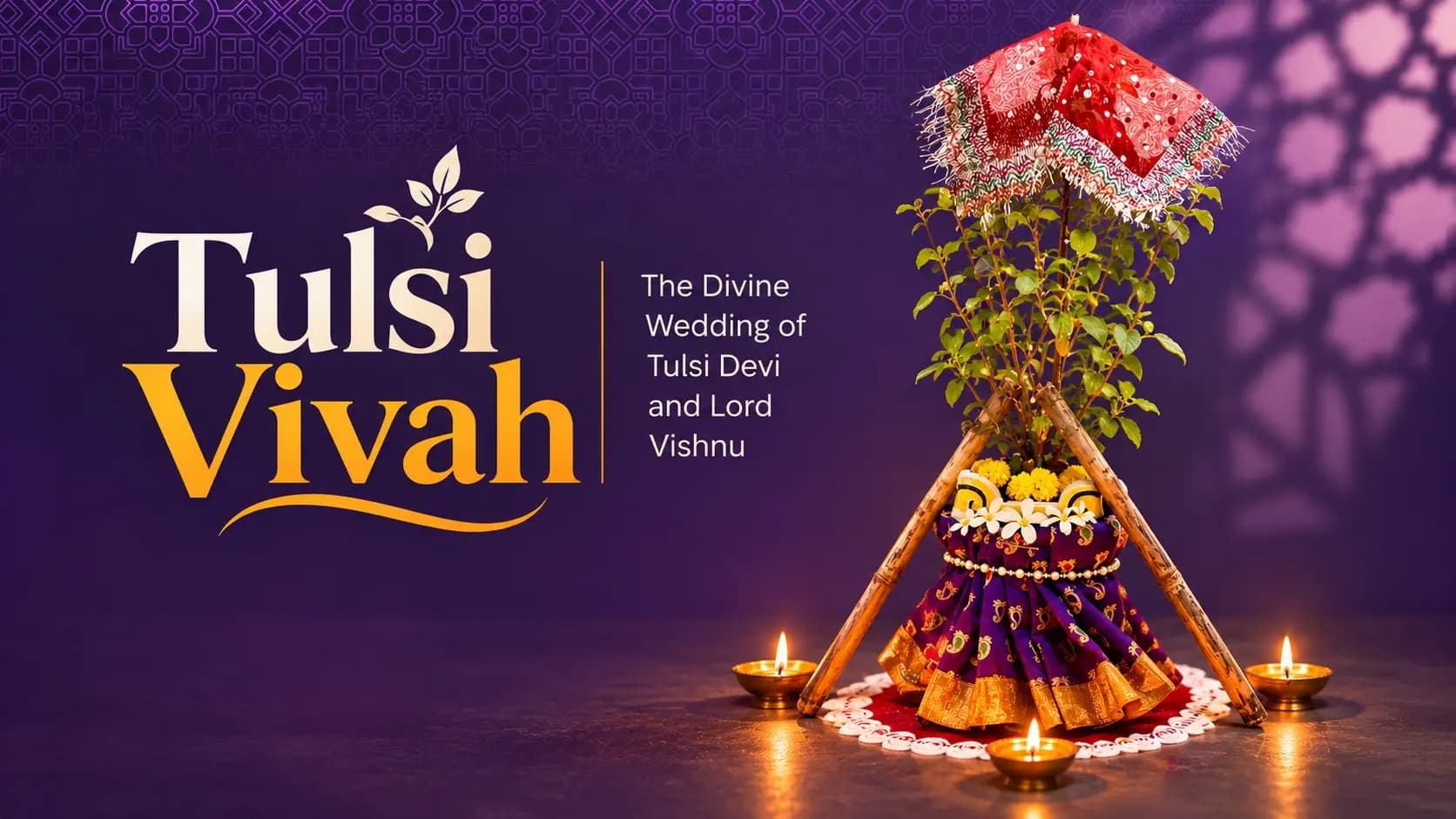
If you grew up in an Indian home, you probably remember this evening. The Tulsi pot in the courtyard gets a fresh coat of geru, sugarcane stalks are tied into a little mandap, someone's old red dupatta becomes the bride's chunri, and the whole family gathers for aarti as the sun goes down. It is one of the warmest, most homely festivals of the year, and you do not need a priest or a big budget to do it well.
Ekadashi, Dwadashi or Purnima: Which Day is Right?
Every year the same question comes up, and different websites give different dates. Here is why. Tulsi Vivah can be performed on any auspicious evening from Prabodhini Ekadashi to Kartik Purnima, so all three days are correct. Families simply follow different traditions.
Prabodhini Ekadashi. Lord Vishnu wakes from his four-month sleep on this day, and many homes and temples hold the wedding at Pradosh kaal the same evening. In some years the Dwadashi tithi begins during the day on Ekadashi, so the evening already falls in Dwadashi.
Kartik Shukla Dwadashi. This is the most widely followed day. Many pandits cite the Padma Purana for it, and the reasoning is simple: Vishnu wakes on Ekadashi, devotees break their Ekadashi fast (parana) on Dwadashi morning, and the wedding follows that evening. Panchangs list the day on which Dwadashi is the tithi at sunrise (the udaya tithi rule). It is the common choice in Maharashtra, Gujarat and South India.
Kartik Purnima. The closing day of the festival, also celebrated as Dev Deepawali. ISKCON and Gaudiya Vaishnava temples celebrate Tulasi-Shaligram Vivaha on this day. If you miss the earlier days, you can still perform Tulsi Vivah on Purnima.
What is Tulsi Vivah?
Tulsi Vivah (also written Tulasi Vivaha) is a Hindu ritual in which the Tulsi plant, revered as Goddess Tulsi or Vrinda and seen as a form of Goddess Lakshmi, is married to Lord Vishnu. Vishnu is represented by a Shaligram, a black fossil stone found in the Gandaki river in Nepal. Some families use a brass idol or picture of Lord Vishnu, Krishna or Balarama, and in South India an amla (Indian gooseberry) branch is common.
The festival goes by different names across India:
Region | Name |
|---|---|
North India | Tulsi Vivah, Tulsi Shaligram Vivah |
Maharashtra | Tulshi Vivah, Tulshicha Lagna |
Andhra Pradesh and Telangana | Tulasi Kalyanam, Ksheerabdi Dwadashi, Utthana Dwadashi |
Karnataka | Tulasi Maduve, Tulasi Habba |
Gujarat | Tulsi Vivah |
The wedding is usually held at the Tulsi Vrindavan, the raised brick or clay planter where many Hindu homes keep their Tulsi plant.
The ceremony follows the steps of a real Hindu wedding: the bride is dressed and adorned, a mandap is built, the groom arrives, the couple is joined, and the family offers kanyadaan, pheras and aarti. Then everyone eats.
Why is Tulsi Vivah Celebrated?
Three reasons sit behind this festival.
Lord Vishnu wakes up. Hindu tradition holds that Vishnu goes into yoga nidra (divine sleep) on Devshayani Ekadashi in Ashadha and wakes four months later on Prabodhini Ekadashi in Kartik. These four months are called Chaturmas, and weddings and other big beginnings are traditionally avoided during this time. The first wedding performed after he wakes is his own, with Tulsi.
The wedding season starts. Because Tulsi Vivah is the first auspicious marriage after Chaturmas, Hindu wedding dates traditionally begin after it. This is why you will often hear wedding planners and pandits say the "shaadi season" starts with Tulsi Vivah.
A promise kept. According to the Puranic story, Vishnu promised Vrinda that she would be worshipped forever and would be united with him. Tulsi Vivah honours that promise every year.
Story
The story of Vrinda and Jalandhar appears in the Skanda Purana, the Padma Purana and the Shiva Purana, and each region tells it a little differently. This is the version most families narrate during the puja.
Vrinda was a deeply devoted follower of Lord Vishnu. She was married to Jalandhar, a mighty asura king born from the energy of Lord Shiva. Jalandhar grew so powerful that he challenged the gods themselves. The secret of his strength was Vrinda's chastity and devotion: as long as she remained faithful and kept praying for him, no one could defeat him.
When Jalandhar went to war against Lord Shiva, the gods turned to Vishnu for help. Vishnu took on Jalandhar's appearance and went to Vrinda. Believing her husband had returned, she broke off her prayers to greet him. Her protective vow was broken in that moment, and Shiva was able to kill Jalandhar in battle.
When Vrinda realised she had been deceived, she was heartbroken. She cursed Vishnu to turn into a stone, which became the Shaligram. She then gave up her life. From the place where she left her body, a Tulsi plant grew.
Moved by her devotion, Vishnu blessed her. He declared that she would be worshipped in every home as Tulsi, that no offering to him would be complete without her leaves, and that in his Shaligram form he would marry her every year. Tulsi Vivah is the celebration of that wedding.
Other Versions of the Legend
The Parvati thread. In some tellings, Jalandhar tries to win Goddess Parvati by disguising himself as Lord Shiva. Vishnu's deception of Vrinda mirrors that trick.
A curse of separation. Some versions say Vrinda cursed Vishnu that he too would one day be separated from his wife. This is linked to his later life as Lord Rama and his separation from Sita.
Three sacred plants. One Puranic account says the gods asked Prakriti (Mother Nature) to comfort Vishnu in his grief. She gave three seeds, which grew into amla (Dhatri), jasmine (Malati) and Tulsi. This is one reason the amla tree is also worshipped in Kartik and is used for Vishnu in the South Indian ritual.
From the ocean of milk. Another tradition says Tulsi was born from a tear of joy that fell from Vishnu's eye into the nectar during the churning of the ocean (Samudra Manthan).
Bhishma Panchak: Five Days Around Tulsi Vivah
The last five days of Kartik, from Prabodhini Ekadashi to Kartik Purnima, are called Bhishma Panchak. They are named after Bhishma Pitamah of the Mahabharata. Many devotees keep a stricter fast during these days, and Tulsi Vivah falls right inside this window.
Significance
Blessings for married life. Women pray for a happy marriage and the wellbeing of their husbands. Unmarried girls pray for a good life partner.
The merit of kanyadaan. Many couples who do not have a daughter take the role of Tulsi's parents and perform her kanyadaan. Giving a daughter in marriage is considered one of the most sacred acts in Hindu tradition.
Tulsi in daily worship. Tulsi leaves are offered in almost every Vishnu and Krishna puja. The festival is a way of thanking the plant that blesses the home all year.
A healthy home. Tulsi (holy basil) has been part of Ayurveda for centuries, and keeping one at home is believed to bring purity and good health to the household.
Tulsi Vivah Samagri List
You do not need everything on this list. A clean Tulsi plant, a Shaligram or Krishna idol, a few flowers, a diya and a sweet are enough for a sincere puja. Here is the full list for those who want to do it traditionally.
For the bride (Tulsi Mata)
Tulsi plant in a clean pot (paint or decorate the pot with geru, haldi or rangoli)
Red chunri or a small saree
Shringar items: bangles, bindi, sindoor, kumkum, mehendi, kajal, a small mirror and comb
Mangalsutra or a red thread
For the Groom (Lord Vishnu)
Shaligram, or an idol or picture of Lord Vishnu or Krishna
Yellow cloth (Vishnu's colour)
Chandan (sandalwood paste)
Janeu (sacred thread)
For the mandap and puja
4 sugarcane stalks for the mandap
Mango leaves and marigold flowers for decoration
Banana leaves (optional)
Kalash with water, coconut and mango leaves
Diya, ghee, cotton wicks, camphor and incense
Roli, haldi, akshat (unbroken rice), supari, paan leaves
Gangajal or clean water
Red string (kalava or mauli)
For bhog and prasad
Seasonal fruits: amla, ber, sitaphal, singhara (water chestnut), sweet potato
Sugarcane pieces
Panchamrit
A sweet such as kheer, halwa or laddoo
Peanuts and coconut
Puja Vidhi at Home
Clean and prepare. Take a bath in the morning. If you kept the Ekadashi fast, break it during the parana time. Many women then fast again until the wedding is done in the evening. Clean the space around the Tulsi plant and draw a rangoli in front of it.
Build the mandap. Tie four sugarcane stalks around the Tulsi pot so they meet at the top like a canopy. Decorate it with mango leaves, marigold garlands and flowers.
Dress the bride. Wrap the red chunri around the Tulsi plant and offer the shringar items: bangles, bindi, sindoor and the rest.
Place the groom. Bathe the Shaligram with panchamrit and then clean water. Dress it in yellow cloth, apply chandan and place it on a small platform to the right of the Tulsi plant. If you do not have a Shaligram, an idol or picture of Lord Vishnu or Krishna works perfectly well.
Start with Ganesh puja. Light the diya and incense. Offer a short prayer to Lord Ganesha so the ceremony goes smoothly, and set up the kalash.
Do the sankalp. Hold a little water, akshat and a flower in your right hand, state your name, gotra and the purpose of the puja, and let the water fall.
Worship the couple. Offer roli, haldi, akshat, flowers and incense to both Tulsi and Shaligram. Tie a red thread between them or around the mandap.
Kanyadaan and pheras. The person playing Tulsi's parent offers her hand in marriage. Traditionally, this role goes to a couple who have no daughter of their own. Then the Shaligram is carried around the Tulsi plant seven times (seven pheras) while the family sings mangal geet or chants. The Maharashtrian way: a white cloth (antarpat) is held between Tulsi and the groom while the Mangalashtak verses are sung. At the word "Shubh mangal saavdhan", the cloth is lowered, everyone showers akshat mixed with kumkum on the couple, and the family claps.
Offer bhog. Place the fruits, sugarcane, sweets and panchamrit before the couple.
Aarti. Perform aarti with a ghee diya and camphor, and sing the Tulsi Mata aarti or "Om Jai Jagdish Hare".
Share the prasad. Share the prasad with family and neighbours, and break your fast if you kept one. Give the bridal items offered to Tulsi to a priest or a married woman of the family. You can also feed Krishna prasadam to people in need through Anna Daan Seva at ISKCON Kurukshetra.
Simple Mantras You Can Chant
Om Namo Bhagavate Vasudevaya (a mantra to Lord Vishnu)
Tulsi pranam mantra: Vrindayai Tulasi-devyai priyayai Keshavasya cha, Krishna-bhakti-prade devi satyavatyai namo namah. (I bow again and again to Vrinda, Tulsi Devi, who is dear to Lord Keshava and who gives devotion to Krishna.)
Celebrations Across India
Maharashtra. Tulsi Vivah is a full family celebration here, held on any evening between Ekadashi and Kartik Purnima. The Tulsi vrindavan is painted, the mandap is decorated with sugarcane, Mangalashtak is sung and akshat showered just as in a human wedding. Many households start fixing wedding dates for their own children only after this.
Gujarat (Saurashtra) and Rajasthan. Temples and communities hold grand Tulsi Vivah processions. In parts of Saurashtra, two temples act as the bride's and groom's families: the bride's temple even sends out wedding invitations, and on Ekadashi the baraat of Lalji (a small image of Vishnu) arrives in a palanquin with singing and dancing. Couples hoping for children often take the role of Tulsi's parents, and bhajans go on through the night.
Uttar Pradesh and Madhya Pradesh. Dev Uthani Ekadashi and Tulsi Vivah are often celebrated together. Families draw the feet of Lord Vishnu with rice paste, offer sugarcane, singhara and seasonal produce, and sing songs to "wake" the Lord.
Bihar. In Saunja village, Tulsi Vivah is a three-day village festival from Ekadashi to Trayodashi. The first day is given to reciting the Ramcharitmanas, the second to a Shobha Yatra (procession), and the third to the tilak ceremony and the wedding itself, followed by a chhappan bhog (56 dishes) offering. Saints and mahants from across Bihar attend.
Andhra Pradesh and Telangana. Tulasi Kalyanam is held on Kartik Shukla Dwadashi, called Ksheerabdi Dwadashi or Utthana Dwadashi. An amla branch is placed in the Tulsi Vrindavan to represent Vishnu, and the couple is worshipped with the full sixteen-step Shodashopachara puja. Homes are lit with rows of lamps in the evening.
Karnataka. Known as Tulasi Maduve or Tulasi Habba, it follows the same Dwadashi tradition, with the Tulsi katte (platform) decorated with lamps and an amla branch beside the plant.
ISKCON and Vaishnava temples. Many Krishna temples hold a Tulsi-Shaligram Vivah Mahotsav with kirtan, a decorated palki for the groom and a feast for devotees.
Tulsi Vivah at ISKCON Kurukshetra
At ISKCON temples, Tulsi is honoured as Tulasi Devi, a dear devotee of Lord Krishna, and no food is offered to the Lord without her leaves. Following the Gaudiya Vaishnava calendar, ISKCON celebrates Tulasi-Shaligram Vivaha every year on Kartik Purnima, the last day of Bhishma Panchak and of the holy month of Kartik.
So if the ISKCON date differs from your local panchang, nothing is wrong. Both fall within the same Ekadashi-to-Purnima window explained above.
Doing it at home the Vaishnava way is simple. Dress the Tulasi pot in a red skirt, adorn her branches with red bangles and kumkum, and offer her a garland. During the ceremony garlands are exchanged, and Tulasi garlands her Lord first.
Dos and Don'ts on Tulsi Vivah
Do
Perform the ceremony in the evening, with a clean body and mind
Use fresh flowers and seasonal fruits
Keep the area around the Tulsi plant clean and lit with a diya
Invite family and neighbours to join; it is a wedding after all
Don't
Pluck Tulsi leaves on the day of Tulsi Vivah (traditionally avoided on Ekadashi and Sundays too). If you need leaves for bhog, pick them a day earlier
Use a dried or wilted Tulsi plant for the ceremony
Offer non-vegetarian food or anything with onion and garlic on this day
Frequently asked questions
Q. What is the last date for Tulsi Vivah in 2027?
Kartik Purnima, Sunday 14 November 2027, is the last day of the Tulsi Vivah window.
Q. Who is Tulsi married to?
Tulsi is married to Lord Vishnu in his Shaligram form. Some families use an idol of Lord Krishna or an amla branch to represent the groom.
Q. Why is Tulsi married to Shaligram?
According to the Puranas, Vrinda cursed Lord Vishnu to become a stone (Shaligram) after he took her husband Jalandhar's form. Vishnu accepted the curse and blessed her to be worshipped as Tulsi and to marry him every year in his Shaligram form.
Q. Should we fast on Tulsi Vivah?
Fasting is optional. Many women keep a fast from morning until the ceremony ends and then break it with prasad.
Hare Krishna Spiritual Journey
Seek the Divine.
Transform Your Soul.
Join the ISKCON KKR community — embrace bhakti, serve with love, and discover your eternal purpose.
About the Author
ISKCON Kurukshetra
A team of devotees dedicated to sharing the timeless wisdom of Vedic scriptures and the teachings of Lord Krishna for the benefit of all seekers.
Our mission is to spread the message of Bhagavad Gita and Srila Prabhupada’s teachings with authenticity and devotion.
Comments